Musinsa is not a label. It’s a Korean fashion ecosystem built at the intersection of commerce and media. Online, it behaves like a demand engine and a taste engine at the same time. It aggregates attention, converts it into transactions, then feeds the loop with editorial, community, and constant curation. Offline, it turns digital momentum into physical proof through stores designed for discovery, speed, and repeat visits.
Shanghai is the next logical step because China is where scale happens, and Anfu Road is where legitimacy is earned.
Anfu Road is a signal street. People don’t go there for convenience. They go there to see what is happening now. If you are introducing an ecosystem, not a single brand, you choose a district where adoption becomes visible in public, where the street itself accelerates diffusion. Musinsa frames the move as a bridge from Seoul’s Seongsu to Shanghai, and the comparison is precise. Seongsu became a retail lab because it rewards hybrid formats, pop-ups, and spaces built for content. Anfu Road plays the same role. It’s not about selling product. It’s about planting a cultural node.
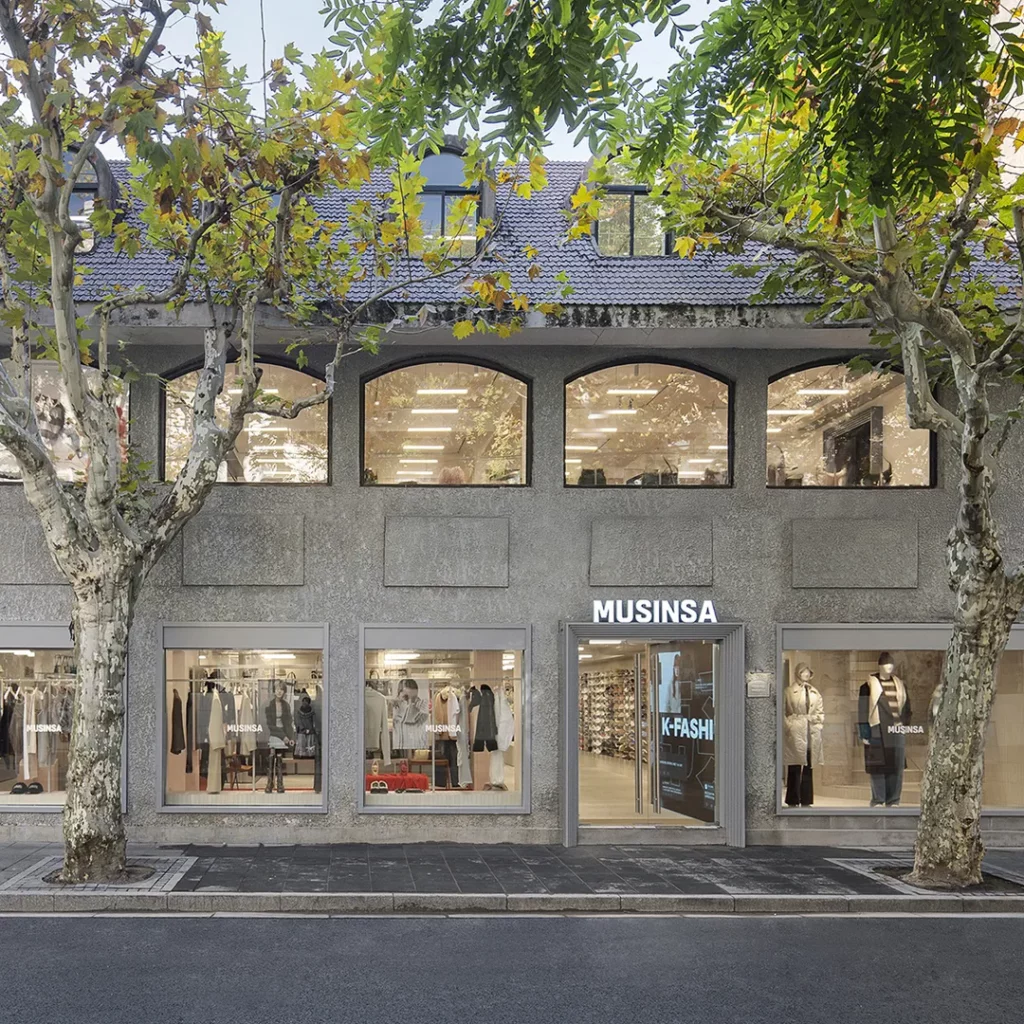
Musinsa Store Shanghai Anfu Road operates across three floors inside a renovated historic building. The format is built like a platform interface. Clear zones, rotation built in, and an experience designed to create reasons to return. Platforms don’t go offline to mimic department stores. They build physical extensions of the feed.
The selection logic is deliberate. The store carries 59 brands in total, mixing Korean fashion and accessories with Chinese and global references to avoid the foreign bubble effect. This is the real localization move. Not translation. Integration. You reduce friction by anchoring discovery inside familiar codes, then introduce Korean brands through curation rather than explanation.
The layout reads like a funnel. The ground floor is engineered for immediacy, pop-ups and high-velocity categories where first-time visitors can convert fast. The objective is simple: turn curiosity into a purchase and a photo. The second floor builds depth through multi-brand styling and discovery. This is where basket size grows and the consumer starts to understand the ecosystem rather than one hero brand. The third floor goes straight to culture with a K-pop themed zone. That’s not decoration. It’s a demand engine. In China, fandom-driven shopping is one of the cleanest conversion mechanics because it is identity plus community plus repetition. Musinsa is not guessing. It is installing a proven demand trigger into the store architecture.
Most retailers optimize for footfall and conversion. Platforms optimize for loop strength. Musinsa is optimizing for attention capture in a district where attention is already concentrated, discovery at scale through a controlled multi-brand environment, social proof because content is distribution, and repeat behavior because habit is what makes offline scalable. This is why the store behaves like a media product. Pop-up zones, rotating edits, culture anchors. The store is designed to produce freshness, because freshness is what keeps a platform alive.
Treat Anfu Road as influence retail. It’s the credibility door. It gives Musinsa a high-signal address that can validate Korean brands in a Chinese context. But the strategy does not stop there. Musinsa is pairing influence retail with a second pillar through Musinsa Standard, built for volume and repetition. Select shop for heat, basics for scale. You need both if you want a network, not a trophy store. This two-pillar logic is how platforms become infrastructure.
If you are a brand, be careful with the fantasy that being stocked inside a platform ecosystem will solve distribution. It won’t. It will amplify what is already true. If your positioning is vague, if your product hierarchy is messy, if your pricing architecture is inconsistent, or if your visual codes are weak, a street like Anfu will expose you fast. The consumer there is allergic to noise. They move on instantly. The brands that win in this format share the same traits: clear identity, tight product ladder, consistent pricing, strong styling logic, and operational discipline.
AMONT note. This opening is a marker of where distribution is going. The strongest operators are building hybrid systems: online demand capture plus offline cultural proof. The store is not the business. The store is the interface. For AMONT, this is exactly why retail intelligence matters. When ecosystems like Musinsa go physical, they change routes to market. They change which streets matter, which formats convert, and which brand profiles travel well across borders. What we track is concrete: doors and addresses, formats and floor logic, brand mixes and category choices, and the mechanism behind the selection. Because once you see the mechanism, you can predict what comes next and position brands accordingly.
- Where:No 201, anfu road, Shanghai
- Online: https://global.musinsa.com
Follow: @musinsa_global