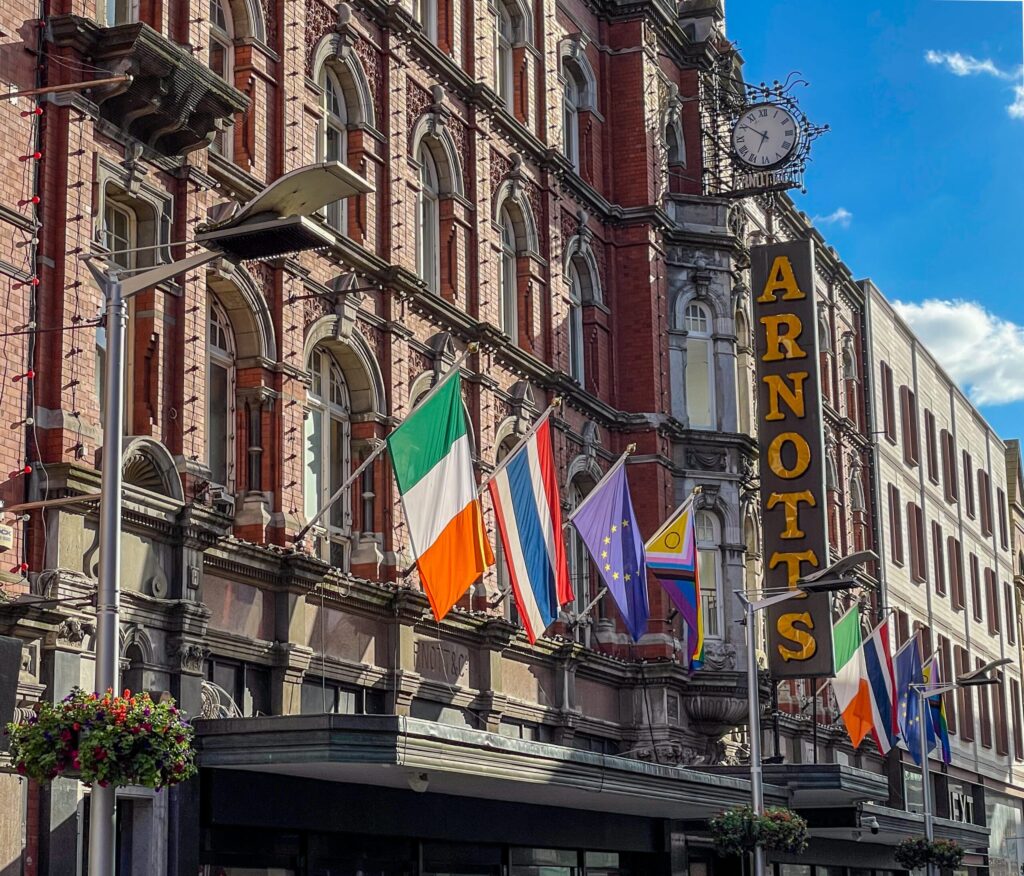
Arnotts occupies a singular position in Irish retail. Located on Henry Street in Dublin, it has long functioned as more than a commercial destination. For decades, it has been a reference point for how fashion, lifestyle, and consumption are experienced in the city. While many department stores across Europe have struggled to redefine themselves, Arnotts has remained embedded in everyday urban life.
Its strength lies in continuity. Arnotts never positioned itself as aggressively trend-led or disruptive. Instead, it built trust through scale, accessibility, and consistency. Generations of Dubliners have used Arnotts as a default destination, not because it chased novelty, but because it reliably reflected the city’s retail standards at each moment in time. That role, often underestimated, is what allowed the store to absorb shifts in fashion cycles, consumer behavior, and competition.
Over time, Arnotts adapted its format without abandoning its fundamentals. The store expanded beyond apparel into beauty, home, food, and services, aligning with department store models that prioritize experience and dwell time rather than pure transaction. This evolution was incremental rather than spectacular, focused on circulation, category interaction, and long-term usability of the space.
What distinguishes Arnotts today is its ability to remain contemporary without erasing its identity. Brand selection balances international labels with relevance to the local market, maintaining accessibility while elevating presentation. The layout encourages movement rather than segmentation, reinforcing its role as a central retail anchor rather than a collection of isolated concessions.
Arnotts also plays a stabilizing role within Dublin’s retail ecosystem. Its presence sustains Henry Street as a commercial artery, supporting surrounding stores and maintaining footfall beyond seasonal peaks. In that sense, Arnotts does not simply respond to the city. It actively shapes how retail functions within it. Few legacy stores retain that level of structural influence.
In an era dominated by digital-first platforms and rapid format experimentation, Arnotts illustrates another path. Legacy retail can remain relevant when it understands its function within a city and evolves without severing ties to its audience. Arnotts does not compete on speed or novelty. It competes on permanence, trust, and integration into daily life.
AMONT note: Arnotts matters because it proves long term retail value comes from adaptation, not disruption. While many historic department stores tried radical reinvention and lost clarity, Arnotts stayed readable to its customers while quietly upgrading its offer. For AMONT, it’s a reminder that distribution is not only about innovation. Endurance, scale, and urban relevance still decide who wins in a retail ecosystem.
Facts: Arnotts Dublin is a landmark department store on Henry Street, positioned in the city’s highest-footfall retail corridor. It operates as a multi-category anchor focused on fashion, beauty and home, built for breadth, accessibility and repeat visits rather than short-lived hype. The retail logic is simple: a recognizable address with a dependable offer, refreshed through seasonal rotations, merchandising and service-led retail. In Dublin’s shopping map, Arnotts functions less like a concept and more like an engine. It stabilizes the street, sets baseline expectations, and keeps traffic moving across the wider area.
Image credit: Kenneth C. Zirkel, CC BY 4.0, via Wikimedia Commons
- Where: Henry Street, Dublin 1, Ireland
- Online: https://www.arnotts.ie
Follow: @arnottsdublin